
Reducing the amount of hand finishing needed with PowerMill
The introduction of new interfaces for Autodesk’s PowerShape, PowerMill and PowerInspect manufacturing software proved very timely for us here at Eccles Tooling Systems, as it coincided with a significant transition in our operating staff. Older members of staff were reaching retirement age and it was difficult to find skilled replacements. We met the challenge by recruiting apprentices and introducing improvement programmes for the older staff we were able to recruit.
Intuitive software helps to onboard new starters
With the Autodesk software being central to the our operations, training in the programs was an important part of the induction of new staff and the benefits of the new interfaces soon became apparent. The new interface style is easier to learn so we were able to get people up to speed more quickly. It also makes the software faster to use, especially for new users. It leads you through the process, whereas previously you often needed to be an experienced user to find the right commands.
We originally introduced CADCAM during the early 1990s and now run six seats of the PowerShape design solution, five of the PowerMill CAM programming software and three of the PowerInspect inspection program, one for a FARO arm and two for static CMMs. The combination of software allows us to provide a full service, comprising design, machining and inspection, plus reverse engineering if required. Here at Eccles Tooling Systems we are big believers that hand work will never go away completely and so have also maintained hand-working skills within the team.
The challenge of maintaining high quality in a growing company

Autodesk software allows us to produce tooling of the highest quality. A steady expansion of our capabilities has seen the arrival of ten CNC machines, all Correas, with the largest having a bed size of 8m x 2m. Two of the machines have full five-axis capabilities, with a further four able to undertake positional five-axis operations.
Eccles Tooling Systems began as a patternmaker to the automotive industry but over the years we have expanded into supplying other types of tooling, including moulds, casting equipment, and jigs and fixtures, as well as prototypes and machined components. Similarly, we has expanded our customer base, mainly in the aerospace industry and, to a lesser extent, in the marine and rail sectors. Over the last five years, we have put an emphasis on increasing our customer base, by taking on projects where other suppliers have claimed that they can’t be done. Our combination of machines and software allow us to undertake more difficult jobs – we like to take on a challenge – plus, when we are successful, the customer will often return with more routine work. Shorter lead times and consistent quality make us more competitive, and ensure that we keep customers that need the higher-level service we provide. With our big machines, we are often making large components that used to need a lot of finishing. Now, they frequently come off the machine ready for delivery.
Software capabilities that grow with the company

Here at Eccles Tooling Systems we specialise in complex projects using the full power of our Autodesk software. In addition to introducing the new interfaces across its manufacturing software, Autodesk has continued to develop the capabilities of the individual programs. In this, PowerShape has become more capable in dealing with data from other CAD systems used by our customers. In particular, it has become much easier to interrogate modified models of parts sent by customers, to find the changes and update the tooling designs accordingly. We were an early adopter of programming on the shop floor and can program all ten machines with our five PowerMill seats simultaneously by running multiple sessions of the software.
Having PowerMill on the shop floor makes it easier to edit programs to reflect the cutters that are available and other changes. In addition, the shop-floor operators can make small CAD changes, such as adding run-off surfaces or capping holes, without having to go back and forth from the design office.
Higher quality finished parts straight off the machine

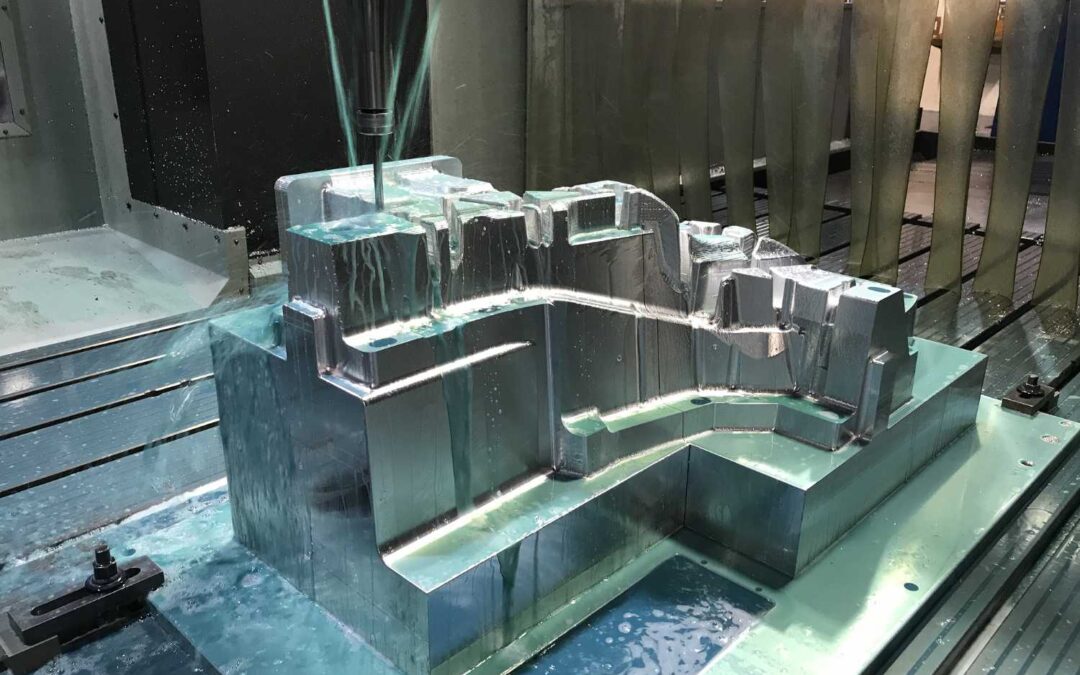
The accuracy of the finish possible with PowerMill means that minimal hand finishing is needed. Enhancements in PowerMill allow us to work more efficiently, in particular to get closer to a finished part on the machine, so reducing hand work and achieving more accurate and more consistent results. With our big machines, we are often making large components that used to need a lot of finishing. Now, they frequently come off the machine ready for delivery.
Like most sub-contractors, we see increasing demand from our customers for comprehensive inspection reports. Reports from PowerInspect now need to be supplied with 99% of the jobs, with inspection often required both against the original CAD data of the customer’s part and against our tooling design. Some customers even ask to be present while the inspection is taking place. Inspection also forms an important part of the ongoing support we provide to our customers. The portability of the FARO arm means that worn tooling can be checked on-site to confirm whether or not it is still within tolerance, and to estimate the cost of any repair that might be necessary.